|
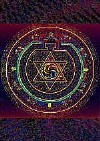
2) Buddhist mandala from Tibet, symbolizing the Universe, the human soul, and the God in the center of Transcendental thought.
3)
Silver coin from the Arab-Ayyubid dynasty,
4) Detail on a carved wooden portal from Anatolian Seljuks; 13th century. Ethnography Museum, Ankara.
6) Author’s interpretation of how the concept of “Magen David (D(awoo)d)” evolved from the Sky*rooT United stamps formed by y+our perception of the universe.
©
Designs by |
MAGEN DAVID IT AIN'T... |
 |
Ancient clues behind the new name To see what lies behind the makeshift name of this symbol, an important but widely unknown aspect of our root syllables must be examined. One clue in this direction is found in Turkish lore, where the “Legend of Oğhuz” narrates that Noah had three sons; of these Japheth had eight; their eldest named Turk 7 had four sons, one with the curious name Amlak 8, which is followed with a question mark in the explanatory text. The meaning of this ancient and purely Turkish name is ignored deliberately by our academia, because it is considered obscene in today’s standard Turkish, somewhat similar to saying “cunt fucker” in English now. The second clue comes from the words amga or amgı korgan, used on the memorial stone monuments of Kül Tigin and Bilge Kaghan near the Orkhun River in Southern Siberia, said to have been erected in 732 and 735 AD. respectively. Here, too, the meaning of the word is dismissed lightly as a“location name” 9. According to my new method of aphonetic but provisual analysis of root syllables, the name Amlak originally meant nothing obscene or vulgar, but was simply an attribute used to identify an able person, in the same manner as Maker or “achiever / creator / producer / mover, etc.” is used in English for someone of some merit. And our second clue, amga (or amgı), is clearly a corruption of the adjective am.gen, which means the kurgan (a tumulus or a fortified place, even a castle ) has the property of being M-sided, with walls jutting out on a triangular plan 10. This explanation is reconfirmed by the design used on the Teke Beyligi’s flag (5th picture on left), showing “a castle over the sea” which in fact is a reference to Attalia (Antalya) harbor being the seat of this Principality. Since the phrase Amgen ~ Magen (M-sided) David does not make any sense other than simply referring to his shield or star (?), we have to find out which original stamp signs shall produce a similar impression in appearance and thus make the spelling of תואת (th(awi)th) or (D(awoo)D) possible in latter day al(e)pha-bet(h)as, while providing us with a more reasonable meaning for its content. The drawing at left shows the outcome of this procedure, which closely resembles the work of a paleontologist over some fossilized debris, as to how and where the name David or its graphic exponent in ış.am : öt.ük (semitic tongues) has been derived from. The renovated stamp signs of y(am.er.ok)y actually mean either y(ay).amrak, the Celestial Bounty / Divine Love, or yumruk, the Wrathful Fist / Vengeance of God, the multi-layered pro & con meanings depending on in which order its root syllables are decrypted. In conclusion, the term am.gen : y(am.er.ok)y embody altogether the idea on how the perpetual duality of God’s Creation & Destruction is manifested in our concept of space / time unity, which is an interlaced, M-sided enclosure, sort of a notched shield for our finite existence. A hidden attribute of am.gen as the symbol of universal timing In addition to all the
esoteric explanations that exist about the hexagram, it must be noted that it is
also a concrete pictoglyph of three hourglasses in the basic form of figure 8
joined end to end
Given each hourglass measures eight hours and their trio trickle down the 24 hours of one day when overturned in sequence, the whole design indicates the biologically optimum times for mankind’s sleep-- work-- rest-- periods; while corresponding respectively with the mystic precept of the Creator’s perpetual work for his creatures’ salvation in the past-, present- & future-tenses, at the very end of which process the suffering but nevertheless faithful souls shall earn the promised prize of eternal bliss in paradise... Such casual idioms, tempus fugit (time runs away); tempus edax rerum (all consuming time); the march of time; sands of time; dust to dust, and Remember the Sabbath day, to keep it holy, etc... are descriptions for this innate comprehension of space / time unity which we have just observed as being encoded in our cosmic am.gen or M-sided stronghold. Curiously enough, this design has an enormous capacity to imply the M-sided points of 12 hours on the dial of a clock and the same number of 5 minute units in one hour, months on the contemporary calendar, signs on the zodiac, cyclical years in the ancient Turkish calendar; plus the number of apostles on Jesus Christ’s dinner list, tribes wandering to and fro in the desert, the major creeping tectonic plates of our earth’s crust, the beys of white tents on the right flank and the beys of black tents on the left flank of Oğhuz Khan’s Court, with their tribes under bird totems, as well as King Arthur’s Skittish-Scottish knights sitting at the round table. Another extremely interesting manifestation of this six pointed star lies in our sensory perception of light wavelengths between 4,000 - 7,700 angstroms as three primary and three secondary ür.üngs, which stand in Turkish for either “color / produce / crying or howling”, each being a manifestation of the universal vibrations of energy. A two-dimensional, flattened diagram for this circumstance is rendered below.
Three primary ür.üng (colors) in the triangle up & three secondary ones down with their negative oğh’s (hues) are reflected inside the hexagon.
Ankara, 08.11.1998 FOOTNOTES 1 “One of the most interesting symbols in use by men of the ancient world, by which they described these inseparable lokas and talas, was what is called in Hindustan Vishnu’s Sign, and which for some unknown reason among European mystics is called Solomon’s Seal. This symbol is one of the most widespread, familiar, and favorite symbols of the Asiatic-European world. –Purucker, G. de; Fundamentals of the Esoteric Philosophy, Theosophical University Press, Ca. 1979, p. 480”; “This hexagram becomes one of the central images of development in a number of cultures: e.g. it is the seal of Vishnu, linked with Kartikeyya (Murugan) in Southern India; is the secret seal of Solomon and the Star of David. The hexagram becomes the basis for ten stages of development in Vishnu and for three, seven, nine and ten stages of development in individuals. As a result Indian traditions of yoga, Hebrew traditions of the Kabbala; near Eastern traditions of Mithra and Egyptian traditions of Serapis are linked. –Veltman, Dr. Kim, New Models for Culture, Overview, from "http://www.sumscorp.com/new_ models_of_culture/overview/#1”; See also: H. S. Santesson, Batık Ülke Mu Uygarlığı; çev. E. Arıkdal-Y. Keskin, p.70, Ruh ve Madde Yayınları, Istanbul 1989; 2 Churchward, James, The Lost Continent of Mu, NY, Ives Washburn (1931); reprinted Paperback Library, N.Y., 1968. 3 Alparslan Salt, Cem Çobanlı; Dharma Ansiklopedi: Parapsikoloji, Mistisizm, Okültizm, Ezoterizm, Teozofi, Spiritüalizm, Neo-spiritüalizm, sayfa 152-153; DHARMA® Yayınları Ansiklopedik Sözlük dizisi, Istanbul 2001. 4 “We do not have to accept the name Solomon nor the pretense that he reigned over the Jews, but we must accept the fact that somewhere in the misty time to which the Jewish records refer there lived and moved among the people of the earth one who was an Adept and given that name afterwards. –Judge, William Q.; The Ocean of Theosophy, p. 9, The Theosophy Co., USA, 1987.” 5 “According to one theory, the six-pointed “shield of David” which adorns the modern Israeli flag, started to become a national symbol with David al-Roy's crusade. “Ever since,” writes Baron, “it has been suggested, the six-cornered ‘shield of David’, theretofore mainly a decorative motif or a magical emblem, began its career toward becoming the chief national-religious symbol of Judaism. Long used interchangeably with the pentagram or the ‘seal of Solomon’, it was attributed to David in mystic and ethical German writings from the thirteenth century on, and appeared on the Jewish flag in Prague in 1527. –Koestler, Arthur, The Thirteenth Tribe, Random House, New York 1976, page 56.” ►“It has been a symbol of Judaism since the 17th century, and since 1897, the emblem of Zionism –Microsoft Encarta Encyclopedia”; See also “Magen David”; Ana Britannica, Cilt 15, Ana Yayıncılık, İst. 1989. 6 “King Solomon’s Seal”; Ariel, The Israeli Review of Arts and Letters; # 106, p.15, Jerusalem 1998; “...pentagram and pentagon have been sacred symbols in esoteric organisations. In ancient Egypt, the symbol for a star was drawn with five points. The ideal of the realised man was to become a star, and to ‘become one of the company of Ra’ –West, John Anthony, Serpent in the Sky, Julian Press, USA 1987, p.53”; “When they wanted to portray the god of the universe, or destiny, or the number 5, they painted a star –Elisabeth, R.; Hieroglyphs of Horapollon, Brussels, 1943, p.54”. 7 According to this genealogy, Turk was also the Titanic big brother of Kültigin, alias Phoenix, who appears in another context to be ap.y(ay).er. am : ot. oğh.uz > Prometheus –DT. 8 Ögel, Bahaeddin, Türk Mitolojisi, I. Cilt, sayfa 377, Türk Tarih Kurumu, Ankara 1989; See also entry in our dictionary am.al.okh+an ~ amlak han; Here it must be noted that Noah’s name is derived from Zoah, where the original stamp Z was perceived --erroneously or not-- as an N; And zoah itself is the retroactive @ transcription of oğhuz in or.okh-khu.ng (orkhun) stamp signs of the Sky*rooT United : Mother Tongue –DT. “The Hebraic story {of the Flood} is but a poor fragment torn from the pavement of the Temple of Truth –Judge, William Q.; The Ocean of Theosophy, p. 16, The Theosophy Co., USA, 1987.” 9 For a chronological and very concise coverage of all the studies involved with Orkhun Monuments, refer to: Tekin, Talât; Orhon Yazıtları, pp. ı-xxıv, Türk Dil Kurumu Yayınları 540, Ankara, 1988. 10 About the advantages of an M-sided castle, this statement from a news report on the US military operations is worth considering: {The commanders} introduced the Colombians to the triangular design the Special Forces favor. Three-sided bunkers require fewer men to defend and allow those inside to cover each other in firefights. –Warrior Class by Linda Robinson; U.S. News & World Report, February 10, 2003, p. 38. |
||
|
|
||
 1)
The
Cosmogonic Diagram of Mu, representing their Sky God and his Creation, the
Universe.
1)
The
Cosmogonic Diagram of Mu, representing their Sky God and his Creation, the
Universe.